Review of “Operational Ambiguity” by F. González de Canales

Review of “Operational Ambiguity” by F. González de Canales

By Marta Pelegrín (MEDIOMUNDO arquitectos)
Published in NEUTRA Magazine No. 20.2025

At MEDIOMUNDO arquitectos, the dialogue between theory and practice is a constant. For this reason, we are pleased to share the review of Operational Ambiguity, the latest book by Francisco González de Canales, published in issue 20 of NEUTRA Magazine. This essay, released by Ediciones Asimétricas, delves into ambiguity as a creative and strategic driver in contemporary architecture.


An essay on ambiguity as a strategy

González de Canales presents the challenge of what he calls “operational ambiguity”, a concept that, far from being contradictory, emerges as a fundamental tool for architectural design and criticism. The author uses Michel Serres’ metaphor of the “rope and the knot” to explain how architecture can oscillate between fixed rules and open spaces, generating environments conducive to interaction and constant reinterpretation by its users.

The book invites readers to discover and propose new ambiguities that can be inserted into the contemporary cultural context, understanding architecture as a field of experimentation and open dialogue.

Reseña de "Ambigüedad operativa", un ensayo de F. González de Canales sobre la ambigüedad como motor creativo en la arquitectura contemporánea.

A critical and referential journey

The review highlights how González de Canales, through thorough documentation, analyses poetic, cultural and architectural practices where ambiguity becomes a creative, communicative and projective strategy. The text not only revisits the etymology and philosophical background of the term, but also connects it with the work of thinkers such as Aristotle, Wittgenstein, Locke, María Zambrano and Ortega y Gasset, emphasising the relationship between ambiguity and the human “vital reason”.

The author identifies paradigmatic examples in the work of architects such as Mies van der Rohe, Le Corbusier, Aldo Rossi, Venturi-Scott Brown, Louis Kahn and Álvaro Siza. In these cases, ambiguity is manifested in the relationship between interior and exterior, in memory and the playful experience of space, in the critique of cultural paradigms, and in the indeterminacy of scales and boundaries.


An invitation to reflection and criticism

Far from immediacy and superficiality, Operational Ambiguity proposes a profound reflection on the role of ambiguity in architecture, inviting us to rethink where a place begins and what value the built environment brings to its inhabitants. The book thus becomes an essential reference for those seeking new critical and creative tools in the architectural field.

At MEDIOMUNDO, we share the view that ambiguity, far from being an obstacle, can open up innovative paths in the design process and in architectural communication, allowing for multiple readings and enriching the experience of space.

We highly recommend this stimulating read to anyone interested in contemporary architecture and the possibilities that ambiguity offers as a driver of innovation and critical thinking.

Download the full review in PDF

Reseña de "Ambigüedad operativa", un ensayo de F. González de Canales sobre la ambigüedad como motor creativo en la arquitectura contemporánea.
Research and Practice on the Margins of Regulatory Norms in Post-War Siedlungen of the Rhine-Main Region

Research and Practice on the Margins of Regulatory Norms in Post-War Siedlungen of the Rhine-Main Region

Introduction to the Study

We are pleased to share the publication of our article in issue 38 of the scientific journal Astrágalo, dedicated to “Emancipatory Housing”. In “Research and Practice on the Margins of Regulatory Norms in Post-War Siedlungen of the Rhine-Main Region”, we address the challenge of updating and transforming social housing built in Germany after the Second World War, especially in the Rhine-Main region.


Rethinking the Post-War Residential Legacy

The article builds on the recent policy of rehabilitating German social housing, focused on constructive and energy improvements, to propose a broader reflection on the inherited space and domestic programme. Although these Siedlungen possess great social, architectural and urban value, many present programmatic obsolescence and limited adaptability to contemporary needs.

Faced with the inertia of normative solutions and standardisation, we defend the importance of small interventions and experimental projects that can initiate emancipatory processes and open up new ways of living. We analyse the case of several neighbourhoods designed by Ernst May’s studio in Mainz, where we tested modular devices and participatory strategies to reprogram domestic and collective spaces.

Actualización de Siedlungen en Rin-Meno
Fig. 3a. 1:10,000 scale map showing the location of the 1950-70 housing estates analysed as a case study, built between 1950-70 on the periphery of Mainz, Germany: 1. Berliner Siedlung; 2. Lerchenberg; 3. Mombach West; 4. Mombach Ost; 5. Neustadt. Fig. 3b. 1:500 scale map of the central area of Berliner Siedlung. M. Pelegrín, F. Pérez. D. Ercin, 2023. Source: Preliminary report of the research project “H&O?”.
Actualización de Siedlungen en Rin-Meno
Fig. 4. Aerial photograph of the Berliner Siedlung housing estate, Mainz, Germany. 1969. Author: Wolfgang Lemp Source: Landeshauptarchiv Koblenz/LU15346

Innovation, Participation and Diversity

Our research proposes integrating not only technical improvements into rehabilitation plans, but also participatory design processes that allow residents to reconfigure their homes and communal spaces according to their actual needs: working from home, caregiving, intergenerational living, etc. The development of modular prototypes and real-scale mock-ups has made it possible to visualise and discuss new possibilities for use and adaptation with residents and administration.

The approach relies on transdisciplinary collaboration between technicians, administration and neighbourhood associations, and seeks to replicate these strategies in other residential complexes in the region, contributing to sustainability, diversity and urban quality of life.

Final Reflections

The work concludes that, alongside physical consolidation and energy improvement measures, it is both possible and necessary to incorporate spatial and typological interventions that respond to the plurality of current ways of living. These small, yet significant transformations allow for population retention, facilitate the coexistence of diverse groups and provide greater flexibility and resilience to the existing residential stock.


Full Reference:

Pelegrín-Rodríguez, M., & Pérez Blanco, F. (2025). Research and Practice on the Margins of Regulatory Norms in Post-War Siedlungen of the Rhine-Main Region. Astrágalo. Cultura De La Arquitectura Y La Ciudad, 1(38), 239-261. https://doi.org/10.12795/astragalo.2025.i38.10

Consult the full article:
You can download the PDF with the full text of the article here

Or, consult the complete issue of the journal at:
View of Research and Practice on the Margins of Regulatory Norms in Post-War Siedlungen of the Rhine-Main Region

Project Exhibition 2023

Project Exhibition 2023

1st Semester Architecture HS-Mainz

During February and March 2024, we had the privilege of coordinating, together with Prof. Dr Marta Pelegrín, the Project Exhibition for the first semester of the 2023 Architecture course at Hochschule Mainz (HS-Mainz), held at Holzstrasse 36 and the LUX Pavilion.

At MEDIOMUNDO arquitectos, we understand architecture as a process of constant research and experimentation. From the very beginning of academic training, we propose a methodology based on direct interaction with space and the optimised, rational, empathetic, and haptic use of materials. Throughout the semester, students developed a sequence of exercises exploring design actions such as folding, unfolding, subtracting, stacking, inverting, twinning, or rhythmising, applied to essential materials like stone, wood, metal, concrete, rammed earth, bamboo, cork, and recycled materials.

This exhibition is the result of a collective effort aimed at fostering creativity, sensitivity, and innovation in architectural design—values that are central to our identity as a practice. We believe in an approach to architectural education that integrates practice, critical reflection, and material experimentation, and we are pleased to share the outcomes of this process with the academic and professional community.

Link PDF

Link Magazine

Exhibition Design, “Audiosphere” Museo Nacional Centro de Arte Reina Sofía

Exhibition Design, “Audiosphere” Museo Nacional Centro de Arte Reina Sofía

Technical Data
Architects/Authors:
MEDIOMUNDO Arquitectos. Marta Pelegrín + Fernando Pérez.
Category:
Exhibition Design
PROGRAMME:
Interior Design. Exhibition and furniture design.
SITUATION:
Reina Sofía museum and art center. Madrid
AREA:
1300m2
DATES:
2018-2020
COLLABORATORS:
Jose Pedraza, Sergio Rodríguez, Leonardo Muñoz, Álvaro Arrans
PROMOTORS:
Museo Nacional Centro de Arte Reina Sofía.
ADVISORS
Antoni Rueda. Lighting
José A Lubiano. Cost planner
PHOTOS:
Joaquín Cortés/ Román Lores (Archivo  MNCARS) y MEDIOMUNDO Arquitectos

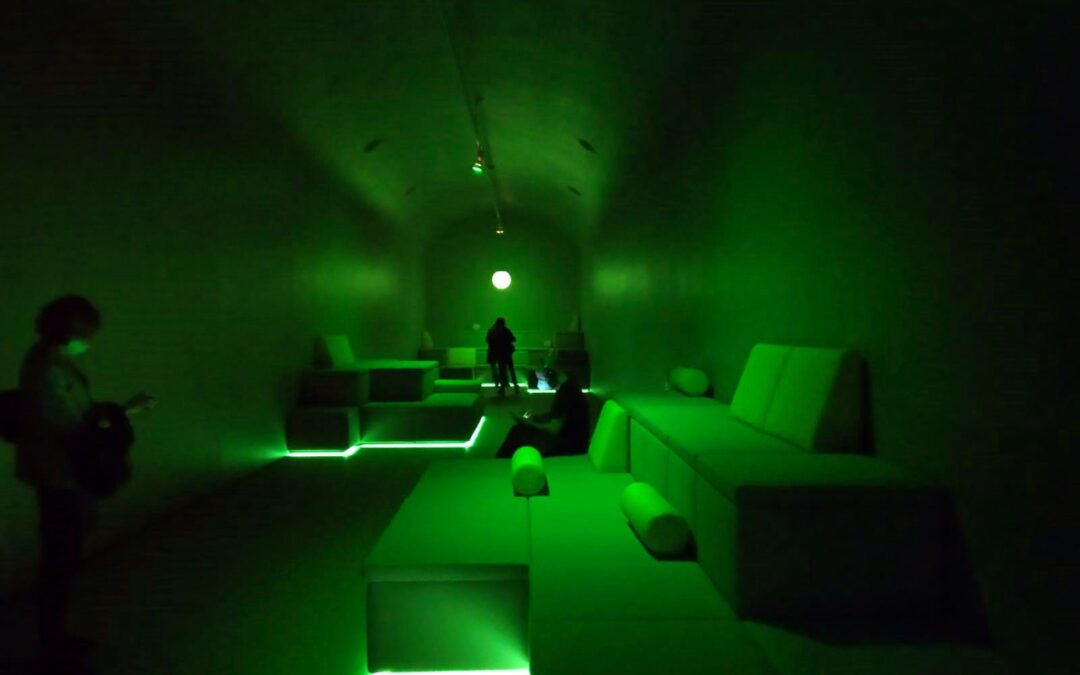
Marta Pelegrín & MEDIOMUNDO arquitectos  have been Commissioned Final Design & Technical Development of fit-out works, advisors and supplier’s management, as well as onsite construction quality surveillance coordination, for the exhibition on Audio Contemporary Social Art curated by Francisco López Reina Sofía National Art Center Museum: April – September 2020, in in the 3rd floor Sabatini Building Reina Sofia Exhibition galleries.

“The objective of this exhibition is to present to the public interested in contemporary art not only a plethora of unknown audio-artists (many of whom have extensive careers spanning decades), but also – and crucially – contents and experiences for a broad reflection on a monumental social process of artistic change in the field of sound creation.

This exhibition also aims to cover a historical and cultural vacuum in the recognition, exhibition and analysis of a essential part of the changes in the artistic conception of work Creative with sound. This poor representation is largely due to the persistence of classic paradigms – significant but overwhelming – stories as the “pioneers”, the “avant-garde”, the linear-chronological (or monophyletic) and, in the specific case of contemporary art, naturally also the Prevalence of the visual and the objectual. This exhibition will therefore present a critical and constructive reconsideration of these paradigms and their effects in the understanding and practice of creative artistic work with sound.

CAAC – ARCHITECTURE – EVERY DAY LIFE PREPOSITIONS

CAAC – ARCHITECTURE – EVERY DAY LIFE PREPOSITIONS

Tecnical Data

ARCHITECTS/AUTHORS:
MEDIO MUNDO Arquitectos. Marta Pelegrín + Fernando Pérez.

PROJECT:
CAAC – ARCHITECTURE – EVERY DAY LIFE PREPOSITIONS
EXHIBITION PLACES:
Oct-Nov.2014 Centro Andaluz de Arte Contemporáneo CAAC.(Spain) Andalusian Centre for Contemporary Art . Hall: The Secadero.
Oct-Nov 2015. MOSTRA ESPANHA 2015(Portugal)Evora School of Architecture, Fundacao Eugenio de Almeida.
Nº ARCHITECTURAL WORKS (DISPLAYED):
26
ESTIMATED AREA OF THE EXHIBITION SPACE:
150-180 m2
Nº SMALL MODELS:
12 (estimated volume 0.20 m3)
TABLE SURFACE:
40 m2
OCCUPIED WALL SURFACE:
30 m2
Nº TV SCREENS:
5 (flexible)
Nº BEAMERS FOR PROJECTING WALL OR FLOOR:
5 (flexible)
MINIMUM HEIGHT SHOWROOM:
280m.
ESTIMATED VOLUME:
1-1.5m3 (books, documents and small models)
ESTIMATED VOLUME:
3m3 (other devices: large model, tables, shelves)

      The program Architecture: Everyday Life Prepositions is an exhibition project, workshops and conference series that has as its goal to show the processes that some spatial practices are involved in. This program gathers together architecture proposals and works that display pragmatic and experimental approaches and which condense and manifest an intense relationship with the urban, social, political and productive environment in which they materialize.

     The attention paid to the direct experience of space and its materiality, the concern regarding the incorporation of the agents that produce, participate and inhabit a built project, and the importance given to the process that the shown architecture projects entail, summarizes an attitude that results in a finished design. The teams of participating architects put forward processes whose techniques and materials mediate between the Zeitgeist (the spirit of an era) and Erfindergeist (their genius). This program sets out in order to show, discuss and develop the links between architectural practice and the social and cultural context in which it is produced.

      An intense critical reflection proliferates in recent architectural debate regarding spatial and material practices, both from within de discipline and beyond it. There are various precedents in contemporary western architectural history that have to do with this. These architectural proposals intervene upon urban space, construct facilities and re-propose the spatial and material configurations of everyday habitat. Within such critical debates, it is not difficult to come across some contradictions or unsolvable aporias. Many classical aporias have been solved thanks to paradigm changes, through world view, episteme or technology. Perhaps, these aporias can be considered indications and initial ways of risk taking, not only in the sense of spatial, material and architectural speculations, but as risks through which new ways of life are tested.

      WORKSHOPS: “UNOCCUPIED: spaces unoccupied in the profession, empty homes and productive spaces”. Duration: 3-4 days (25 hours=1 European credit) Number of participants: 15+15+15 15 Architecture (and similar studies) Master degree and graduate students Number of professors and coordinators: 3 .Conferences: 3( Guests ) + 3round tables and debate forums
SUPPORTS: CAAC, UNIA Universidad Internacional de Andalucía, Goethe Institut, Institut François, CICUS Fundation for Andalusian Studies y Entrepreneur Centre Culture Seville University, research group HUM-666. For MOSTRA ESPANHA2015 Ministry of Culture, Education and Sports. University of Evora.
Curatorship+Production: MARTA PELEGRÍN+ FERNANDO PEREZ, MEDIOMUNDO architects